A History of the World Environment Day Festival (WEDFest) on the Sunshine Coast - Many thanks to Elaine Green for providing this historical record.
In 1972 the first major conference on global environmental issues was convened by the United Nations and held from 5 June – 16 June in Stockholm, Sweden. On 15th December of the same year, the General Assembly adopted a resolution to declare 5th June as World Environment Day and in 1973 the first World Environment Day was celebrated to raise awareness of issues such as depletion of the ozone layer of the earth, global warming, growing desertification and toxic chemicals.
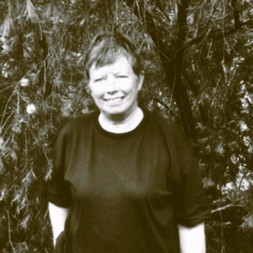 On the Sunshine Coast Barbara Hansa (pictured left) and Alex Hansa, proprietors of Fairhill Nursery, hosted the first World Environment Day (WED) Festival in 1978 in the grounds of their native plant nursery at Yandina. It was a real family affair with involvement by schools, the Nambour Education Resource Centre and lots of our young children. It was coordinated by a committee which included people who later became part of SCEC.
The WED Festival continued as a community event at Fairhill in 1979, 1980, 1981 and the last Festival held in the Fairhill Nursery gardens was in 1982. Cr Jim Cash was the official opener and Barbara Hansa the Coordinator. The ambitious three-day program for World Environment Week 1982 included a film and slide night in the old Plaza Theatre in Currie Street, Nambour with a documentary - appropriately titled Say Goodbye - on Endangered Species. There was a dance at Yandina School of Arts on the Friday night and the Festival at Fairhill on Saturday with music and bush songs around a campfire in the evening.
In 1983 the Festival went to Petrie Creek Park in Nambour.
The minutes show that - It was moved Paul O’Donnell and seconded Karen Robinson that “Barbara Hansa be coordinator of Environment Day and that she form a congenial committee”. Carried! However, the Festival had been gaining a larger following each year and quickly outgrew the Petrie Creek venue.
The Festival moves to Cotton Tree
At the first Festival in 1984, 200 Cotton Trees, Melaleucas and Swamp oaks were planted. Poet and Indigenous activist Oojeroo Noonuccal (Kath Walker) opened the Festival. Judith Durham of the Seekers fame with her husband, musician Ron Edgeworth, performed a number of original songs specially written to commemorate World Environment Day. Feet were tapping along with the popular local Blowfly Bush Band; the Jazz Action Society added to the ambience; the Mandala Dancers displayed traditional folk dances and a Tai Chi performance was then quite a novelty.
An estimated 3,000 people attended the first Festival at Cotton Tree. There were 30 stalls with 22 community groups. The theme was Keep the Sunshine Coast Clean and Green.
The WED Festival was then held at Cotton Tree from 1984 until 2004. It brought together thousands of people – many of whom would look forward to catching up with old friends each year and provided member groups with fundraising and promotional opportunities – as well as highlighting the environmental issues of the times.
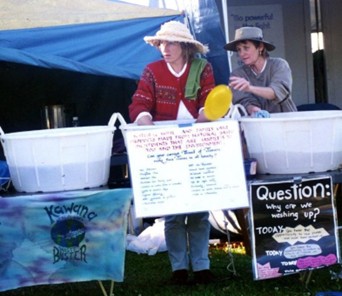 A feature of the festivals at Cotton Tree in the early days was the Kawana Waste Busters washing up tent which collected, washed and distributed for re-use cups, plates and bowls to reduce disposable waste. Many dedicated volunteers worked there. The picture on the right shows the washing up tent (Wendy Lyons (left); Ann Wensley (right).Ivan Mabbs from Enviroflo provided the hot water heated on site by the sun.
Publicity was by way of hand-drawn posters, photocopied in black and white, sometimes on coloured paper if the budget ran to it, and children were encouraged to colour in the posters which went on noticeboards all around the region.
The 80s
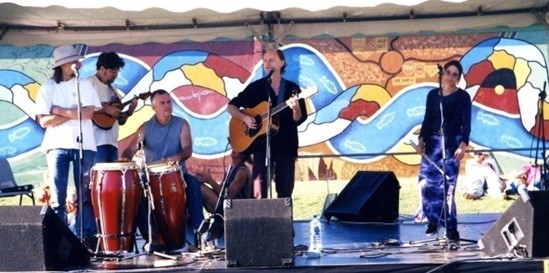
 The 1986 Festival celebrated the International year of Peace with (then) Dr Ian Lowe speaking to highlight peace and disarmament issues. The official theme was Wetlands with the slogan They’re not just for the birds and WPSQ Director Don Henry spoke about their importance as well as the need to increase Queensland’s National Park estate. Noel Gardner and Mark Gillette first performed and became a fixture at subsequent Festivals with their signature songs about environmental issues.
In 1987 the Festival was held at Lions Park in Noosa to celebrate the 25th anniversary of SCEC member group Noosa Parks Association.
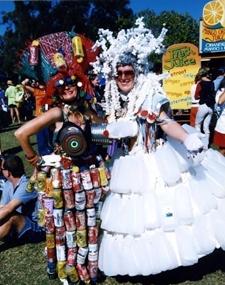
Recycled fashion
By 1988 the Greenhouse Effect and Ozone layer depletion were grabbing headlines. The environment was being seriously discussed in the media and people were hungry for information. Waste Busters came on board to minimise and recycle waste and attendances continued to grow. The raised native gardens on the east and west of the park were planted at the festival with financial assistance from Cr Charmaine Foley in 1989.
The Festival was completely run by volunteers and a group effort with Karen Robinson, Ganga Hawkins and Elaine Green acknowledged as overall coordinators during the 1980s
The 90s - The Mural at Cotton Tree June 7th, 1992
1992 was declared the Year of the River in Maroochy Shire and an ambitious project was undertaken by SCEC with the support of Maroochy Shire Council to paint a mural depicting the history of the Maroochy River as part of the WED Festival. The idea was to have both indigenous and non-indigenous artists working together and the project was undertaken with permission from the Kabi Kabi Aborignal Corporation (now Gubbi Gubbi).
Three of the artists, Joanne Currie, Kaeleen Hunter and Elli Schlunke worked together to come up with the concept. Blair MacNamara, Vicki Turner and others assisted in the painting.
It was decided that the Maroochy River would wind along the length of the wall. The Rainbow Serpent intertwined with the river, acknowledging its primary role in creation. The two heads of the river were shaped like swan’s heads, representing the role of the black swan in the legend of the river’s formation. Scenes depicted included Before Europeans, the Invasion, The Present Day and the Future with the land healed, black and white people caring for the land together. This tied in with the United Nations theme for the year One Earth – Caring and Sharing.
Unfortunately the mural was later vandalised but repainted by the artists. Sadly in 2024 the wall was painted with a new mural advertising a trial of Containers for Change by the Sunshine Coast Regional Council. Forty public bins in the park provide facilities to recycle eligible containers and the Rainbow Serpent mural has become part of history consigned to memory.
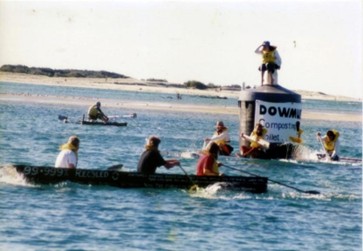 In the 1990s Des Ritchie brought hand drawn flowcharts to oversee the organisation of the Festival which became bigger every year. Coordinator Susie Chapman brought a new dimension. Susie introduced the Water Tent to bring under one roof community and government groups working on water-related issues; the Bike Rally to encourage sustainable transport and the amazing recycled Raft Regatta that raced from the bridge on Cornmeal Creek to the Festival site.
The last Festival in the old millennium in 1999 demonstrated how far it had come with an absolute feast of music with 2 stages and 10 bands. Maroochy Mayor Don Culley came along to present the RADF awards and there was a large Childrens’ Festival area.
Key coordinators were Alison Joy Smith, L B Joum, Yvette Nirvana, Sue Decker, Sylvia Splitgerber, Liam McCafferty, Karen Robinson, Janet Millington, Christine Liebergreen, Shawn Ryan, Danny Campbell, Joy McNamara, Lucy Willy, Linda Jenkin, Jamie Quarrel, Elaine Green, Des Ritchie, Susie Chapman, Stuart Ransom, Phil Gordon, Lyn Dickinson, Noela Thompson, Christopher Dean, Ljuba Djordjevic, Hanni Ellerbock, Paul Willett, unfortunately the written records of the time were not expansive. Apologies to those omitted.
2000s Highlights
In an inauspicious start to the new millennium, the 2000 event was cancelled due to heavy rainfall. Nonetheless coordinator Alison Joy Smith took it on again in 2001 and 2002. Jenifer St George was employed by SCEC as marketing manager. A crowd of around 6,000 attended in 2001 and 500 native trees were given away. It was the International Year of Volunteers and State MP for Nicklin, Peter Wellington, was the official opener. Posters were now in full colour!
Coordinator LB Joum introduced some new concepts in 2003, including the Aboriginal and Islander Heritage Tent with traditional and contemporary arts and crafts and activities, plus the New Ground Sound solar-powered tepee featuring electronic music and a chill zone. A real sign of how far the environment had come as a political issue was the attendance of not but two State MPs, Dean Wells and Merri Rose. Public liability and the cost of coverage had become a real issue that threatened community events. The Festival was held in conjunction with the Maroochy Mooloolah Catchment Coordinating Association, which allowed insurance coverage under Landcare.
There was serious discussion about whether SCEC should continue to host the WED Festival due to the massive effort it took to stage the event. However a 2004, a $10,000 sponsorship package that led to naming rights for the Toyota Prius World Environment Day, saved the day, showcasing one of the first hybrid fuel efficient cars.
Coordinator was Yvette Nirvana and a highlight was the launch of Splash! coordinated by Susie Chapman as the audience formed a human chain and a raft printed with the footprints of the frog was passed form the stage to the water’s edge. The launch of the raft was accompanied by drumming form the stage signaling the start of a wonderful parade of children in costumes around the Festival site.
Changes!
The Cotton Tree site was not available in 2005 and a new venue had to be found. The site chosen was the Eumundi Ampitheatre adjacent to the Eumundi Markets. The stage was the centrepiece with seating on the grassy slope with old faithfuls like Barry Charles on the program along with the Big Marimba, Michelle Brown, Ton Clooney, Diva D, gossamer gia and Sanseriff. It was coordinated by Elaine Green and Jamie Quarrell.
In 2006 the venue was again at Eumundi. This was the first time a Speakers’ Forum was held in its own venue. Topics included depleted uranium, an emerging health legacy from the 2004-05 Gulf War, Dumb Dams and Smart Solutions, and other issues under the thematic banner of Using Resources Wisely. However the site was not without its logistical challenges and the following year another major break with tradition followed.
In 2007 WED was celebrated as a two-day event that included a conference and a community expo called Toward 2020 Climate Change Expo hosted by SCEC in conjunction with Maroochy Shire Council. It was held at the Twin Waters Resort and coordinated by Karen Robinson and Sharon Stott (Council). It was opened by then Mayor Joe Natoli and Prof Ian Lowe provided a thoughtful keynote address titled Positive Responses to Climate Change. Ian Lowe facilitated a “hypothetical” on climate change scenarios putting politicians and experts in the hotspot. An exhibition on sustainable living provided more food for thought.
WED goes to Uni
In another major change, a partnership between SCEC, the University of the Sunshine Coast and Sunshine Coast Regional Council supported by SEQ Catchments, brought the WED Festival site to the Sippy Downs campus in 2008. It was the first year of the newly amalgamated Sunshine Coast Regional Council.
However, the best laid plans… The event had to be postponed due to heavy rain but was held a month later. Coodinator was Diana Dummett, with Jen Mazoudier, Phil Roslan and Stuart Ransom, and the theme was Small Footprints Big Steps: Our Region’s Future. The largely under cover site featured a Farmers’ Market, Transition Town and Green Business exhibits with talks in two lecture theatres. A forum explored how to implement sustainability on the Sunshine Coast with Mayor Bob Abbott leading the discussion. The outdoor stage area was smaller and the following year, as the partnership continued, it moved to a larger more open area. The venue offered a myriad of possibilities in terms of space and shelter that had never been previously available.
In 2009 a month of celebrations in June was held for the first time, starting with the Council’s Living Smart “Glossies” Awards and spread across the region to culminate in the WED Festival. The budget was now big bickies, around $50,000 and the paid coordinator was Helen Langlois.
The partnership was paying great dividends in terms of developing the event. More space allowed for expansion of themed areas and art installations. The undercover venues reduced the threat of rain and the Festival was reaching a wider audience.
At the 2010 festival a great calendar of events for Green June was run and public education continued with a Low CO2 exhibition along with the Green Biz Expo and community information stalls. The Eco Flicks were run for the first time.
The WED Festival for 2011 was billed as a festival of ideas. A new format was introduced with themed areas focussing on topics such as energy, transport and food with a great Speakers’ Program. The professional marketing report indicated there were 116 exhibitors, 22 presentations, 54 stories across print, radio and TV media, over 5,000 view on the Festival website and an estimated attendance of 8,000 people.
The 2012 event was recognised internationally by the United Nations Environmental program (UNEP) in the WED 2012 Challenge finishing in the top five out of over 10,000 entries.
The slogan was your gateway to the green economy and a green marketplace featured 40 local businesses doing the right thing. A further 80 exhibitors from the community and public sector provided a wide array of information and connections for people wanting involvement in caring for the environment. Themed areas were food, water, transport, home and garden, energy, with two new areas to highlight sustainable fashion and lifestyle and waste management.
The WED Festival was certainly coming of age as the 2013 event celebrated 35 years since the first WED Festival on the Sunshine Coast. Every year the organisers knocked themselves out to get the best of innovation and new technology involved in the Festival and to reach a diverse audience that included well organised and educative activities for children.
By 2015 the benefits of the partnership had matured the event by working with professional marketing companies, the development of a WED logo and brand and the use of Facebook and the SCEC website as the main forms of year round communication. However in 2015 the seven-year partnership came to an end and the WED Festival returned to Cotton Tree.
Back to Cotton Tree
The 2016 WED Festival returned to the beautiful shores of the Maroochy River estuary at Cotton Tree but in a new location that allowed the expanded format to continue with a renewables expo and 57 community stalls. It stretched to encompass children’s play grounds as part of the Children’s Forest. A wonderful highlight was the bar on a jetty reaching out over the water. Nearby there were live contemporary street art activities. The Sunshine Coast Regional Council ran a Workshop Yurt and Noosa Council sponsored a Speakers’ Dome.
Coordinator Leah Hays quickly realised the limitations of power to the site and thus the Solar Sunflower made its debut. This was a solar powered generator developed by the Southern Cross University that featured what was then cutting edge technology with lithium battery storage.
The 2017, 2018 and 2019 Festivals (coordinated by Natalie Frost) refined the layout and attracted 75 stalls plus the renewables expo and around 8,000 people. In a testament to the event and to SCEC as its organiser, the 2017 WED Festival was the Queensland winner of the Australian Event Award for Best Charity or Cause-Related event, as well as being a national finalist.
The sustainability of the WED Festival event was again being discussed as it took an inordinate amount of time to coordinate. The Festivals always made an extra effort with waste and by this time all food and drink outlets used recyclable materials and onsite waste was fully sorted. The community had embraced the return of the Festival to Cotton Tree but the last festival there was celebrated with no knowledge of what was to come in 2020 that effectively put a hold on large community gatherings.
2020 and Beyond
Faced with the Covid19 pandemic, the future of World Environment Day (WED) was questioned. Rather than cancelling due to the public health directives, SCEC opted to reimagine the event into a weekend long online event. Videos were submitted from member groups and a live steam set up from a dedicated recording studio the University of the Sunshine (USC). The online event included live and pre-recorded performances from local bands, community groups, expert panel discussions and demonstrations.
The studio featured an installation by artist and dedicated SCEC volunteer Rose Feely which showcased the diversity of local flora. The event began on Friday, 5 June at 12 pm with a live stream featuring the launch of author Sarah Pye’s new book, ‘Saving Sun Bears’ hosted by ABC Mornings Annie Gaffney. Narelle McCarthy did a fabulous job of hosting the remainder of the afternoon’s program which featured member group spotlights and the announcement of the Queensland Conservation Council’s photography competition winners. The Sunday live stream was the highlight of the festival with Channel 7 Presenter Rosanna Natoli as the MC for the day.
The event wasn't without its complications however. As this was the first time SCEC had run an event like this, there were plenty of technical challenges to overcome and a steep learning curve with only 7 weeks to plan the event. A Renewables Expo coordinated by Sunshine Coast Climate Action Now (SCCAN) showcased local companies including tiny houses, boats, scooters, bikes and more. The content reached over 100,000 people and was showcased on the WED website for 12 months.
As Covid19 continued to impact the operational capability of World Environment Day Festival in 2021, a sub-committee of the SCEC Management Committee was formed to evaluate the options. After discussions and review it was decided to deliver the Festival as a month-long program of events and activities, rather than a large one day event. The delivery of the 2021 festival was designed to be an event that reduced financial and resourcing risk whilst still offering an engaging and immersive program. The events were curated around the theme based on the United Nations decade of Ecosystem Restoration that was launched on World Environment Day (June 5th). Given that the SCEC member groups are primarily land based restoration community groups, their regular activities and events aligned well.
There were 43 separate events delivered, 1500 trees planted across multiple sites, 26kgs of litter collected from Caloundra beaches and 25 ecosystem restoration projects showcasing 18 community groups highlighted. The evolution of the WED Festival top this format meant it was engaging with a new, diverse and much wider audience.
Following the success of the 2021 month long program of events, the 2022 Festival followed the same format. After evaluating key learnings from the new format with SCEC member groups the festival was refined to a smaller program to allow ease of management. The theme was Only One Earth and the program had a range of events that called for action for nature, climate and pollution, showcasing practical initiatives to protect our ecosystems.
This concept of having the WED festival day spread over a month and having member groups provide activities in their specific locations was a major innovation and is seen as the way forward, as it embraces the concept of member group empowerment and engagement with the public, raising awareness of the array of environmental issues facing the region.
Importantly, after more than forty five years, SCEC’s Sunshine Coast World Environment Day Festival is still celebrated.